


Wanderrouten in den belgischen ARdennen
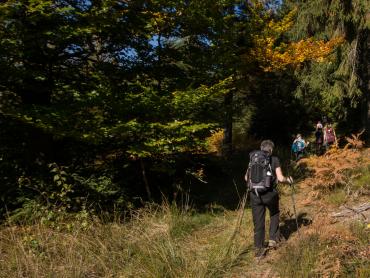
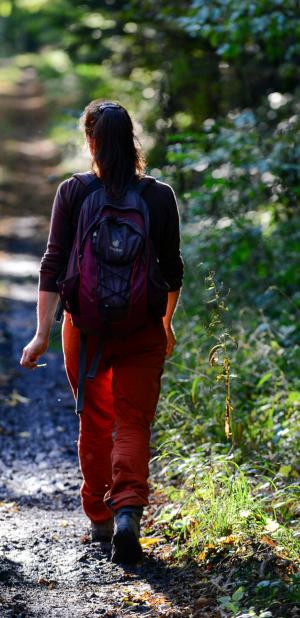
Die belgischen Ardennen erstrecken sich über die Provinzen Namur, Lüttich und Luxemburg, sowie einen Teil der Provinz Hennegau. Es gibt also zahlreiche Wandermöglichkeiten – die perfekte Spielwiese für alle Freunde des sanften Tourismus. Durch den Wald, über Felder, vorbei an Städten oder Dörfern, am Wasser entlang oder über felsige Bergrücken - es gibt für jeden Geschmack etwas.

Practice type
Walking
1h20mn
Nordic walking
Promenade de l'écureuil

Starting from the village of Beaumont, the Squirrel Walk takes you through fields and forests to discover the heights of the southern slope of the Amblève valley. You will pass the pretty isolated village of Francheville. Parking is available near the village hall. have a look to the Route-Info number 1.
Signalétique (EN)
Pedestrian - Horizontal rectangle - Blue
Difficulty
Duration
1h20mn
Dist.
6.6 km
Practice type
Walking
1h20mn
Nordic walking
Show more information
À proximité
Nearby tours
Nearby of points of interest
Map background choice

IGN Map

Aerial Photos / IGN

Slope Map (IGN Plan)

Map 1950 / IGN

State Major Map (1820-1866)

Open Street Map
Lat : 50.38026Lng : 5.995
Coordinates copied

Spa Hautes-Fagnes Ardennes
Author
Village of Beaumont
Places of interest
The village of Beaumont is located halfway between the towns of Malmedy and Stavelot. It is surrounded by the hamlets of Lodomez, Villers and Planche (Malmedy).Beaumont still has several old timber framing farmhouses. At the central crossroads, there is a statue of the Virgin Mary sheltered in a small artificial cave, as well as an old fountain that is still in operation.
7 Beaumont 4970 Stavelot
Viewpoint - Above Le Wérihay
Places of interest
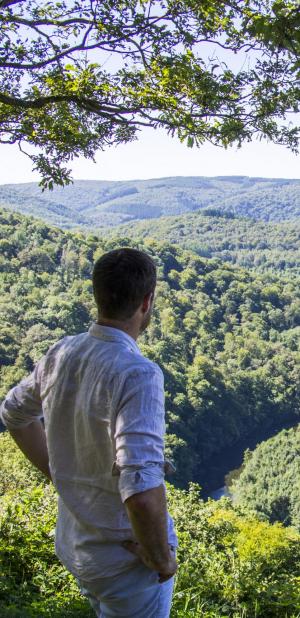
Magnificent view of the Amblève valley above Le Wérihay.On the other side, on the right, you can see the church of the village of Bellevaux, located in the commune of Malmedy.
2 Beaumont 4970 Stavelot
Second viewpoint on the Amblève valley
Places of interest
Viewpoint on the top of the village of Bellevaux (Malmedy).
Unnamed Road 4970 Stavelot
Didactic panel
Places of interest
Didactic panel about the nature reserve of Noir Ruy (or Noir Ru) meaning "black creek". This little creek flows into the Amblève below the village of Beaumont.
4970 Stavelot
Francheville
Places of interest
Set back from the main road coming from Beaumont, the village of Francheville culminates at an altitude of 580 metres and is dominated by the Saint-Félix church built in the 18th century. Above the church's portal are a coat of arms and a chronogram showing the year 1742.The chronogram is an inscription in which certain letters correspond to Roman numerals which, when added together, give the founding date of the building.
9 Francheville 4970 Stavelot
AlertAlerts
Powered by Cirkwi - Read Terms of Use