



All our hiking trails
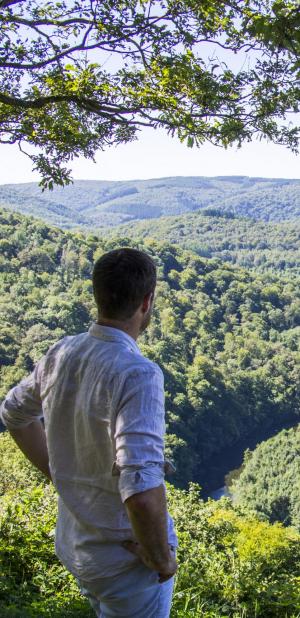
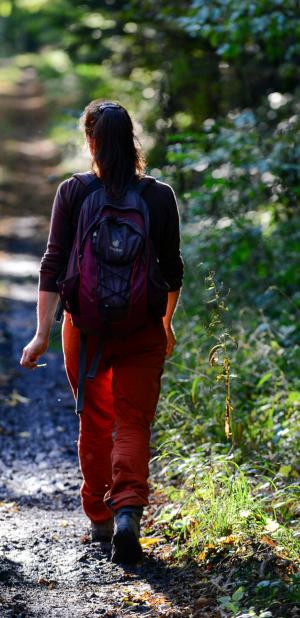
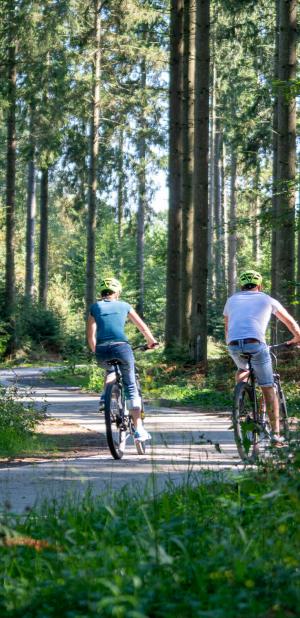
The hiking trails in the Ardennes are as diverse as the landscapes they traverse. Whether you are looking for a peaceful hike in the heart of the forest, along a river or through authentic villages, the Ardennes offers a multitude of choices! The routes are adapted to your level and your desires.
Choose your hike, put on your boots and enjoy!

Practice type
Walking
Historical centre (1/2): Hors-Château and Saint-Lambert

This route invites you to discover many major sites, such as Le Grand Curtius (a museum entirely dedicated to the history of Liège), the Collégiale Saint-Barthélemy (Saint Bartholomew’s collegiate church) and its famous baptismal fonts and Rue Hors-Château. The latter, lined with many picturesque cul-de-sacs, is the former convent of the Friars Minors, but is today occupied by the Musée de la Vie wallonne (Museum of Walloon Life). Also worth the detour is the impressive Montagne de Bueren (Bueren steps), the gateway to the Coteaux de la Citadelle (Hillsides of the Citadel).
The route ends at Place du Marché (Market square) and Place Saint-Lambert (Saint-Lambert Square). These two squares are home to four emblematic sites: the Perron, which is the symbol of the city, the Hôtel de Ville (city hall), the Palais des prince-évêques (Palace of the Prince-Bishops) and Place Saint-Lambert. Located on the site of the former Notre-Dame et Saint Lambert cathedral, below Place Saint-Lambert the Archéoforum, a museum displaying the remains of the former cathedral, can be found.
Signalétique (EN)
No signage
Walking
Difficulty
Not specified
Dist.
2.1 km
Practice type
Walking
Show more information
À proximité
Nearby tours
Nearby of points of interest
Map background choice

IGN Map

Aerial Photos / IGN

Slope Map (IGN Plan)

Map 1950 / IGN

State Major Map (1820-1866)

Open Street Map
Lat : 50.64506Lng : 5.57901
Coordinates copied
Maison du tourisme du Pays de Liège
Author
Maison du Tourisme du Pays De Liège (The butcher’s hall)
Information
This former meat market is one of the city’s oldest civil buildings. Erected in 1546, it was built for the butchers’ corporation, called Les Mangons in Liège. Their coat of arms is visible above each entrance. The interior, with its 16th-century wooden roof frames and columns, is worth the detour. It was renovated in the 1990s and plays host to the Liège tourist information office
4 Rue de la Boucherie 4000 Liège
La Batte
Places of interest
Spread along the banks of the Meuse River, La Batte is the name given to the Sunday market in Liège. In Walloon, the word batte means an embankment or quay. Often presented as the oldest and biggest market in Belgium, La Batte is a very colourful place that attracts many visitors, including many inhabitants of neighbouring countries. It is therefore not rare to hear words in German or Dutch. On Sundays, it is often a good excuse for a stroll along the quays of the Meuse River.
Quai de la Goffe 4000 Liège
Fontaine Montéfiore (Montéfiore fountains)
Places of interest
Hortense Montéfiore-Bischoffsheim offered the City of Liège eleven fountain-drinking troughs, installed in 1889. She repeated this donation in 1891 by offering ten new fountains, which were crowned by a water bearer, sculpted by Léopold Harzé. Of these two donations, only one series has been conserved.The distinctive feature of these fountain-drinking troughs, simply called Montéfiore fountains, lies in their basins intended for quenching animals’ thirst. The name of their benefactor is still visible on the rim of the larger basin on each fountain.
Rue Sur les Foulons 4000 Liège
Ansembourg
Places of interest
The Hôtel Ansembourg is occupied by the museum of the same name. Built in 1738 for Michel Willems, as the initials on the balcony infer, this townhouse is a fine example of the Regency style. However, the building took on the name of Ansembourg, the family that occupied the premises for sixty years. Transformed into a museum at the beginning of the 20th century, the Hôtel d’Ansembourg is currently closed for renovation.
114 Féronstrée 4000 Liège
Le Grand Curtius (museum)
Places of interest
Museum
Opened in 2009, the Grand Curtius brings together religious art, Mosan art, weaponry, decorative art, glassware and archaeology collections. Over a floor-space of 5000 m², it allows visitors to discover art and history in the Liège region. Finally, the museum is located in former prestigious residences, such as the Hôtel de Hayme de Bomal and the Palais Curtius.
Palais Curtius and Hôtel de Hayme de Bomal
With stone-banding that punctuates its façade, its small windows or also the basreliefs (mascarons) that decorate it, the Palais Curtius is one of the city’s emblematic buildings constructed in the Mosan style. This sumptuous edifice was erected between 1597 and 1604 for Jean Curtius, a munitions supplier for the Spanish army, who used it as a store and reception venue. It was initially part of a vast property that covered all the land between Quai de Maestricht and Féronstrée. The Hôtel de Hayme de Bomal, located at the other end of the museum complex, was built between 1775 and 1778 in a neo-classical style. The building pays remarkable witness to that era and boasts lavish interior decors. It was used as the city’s administrative centre during the period of French rule, during which Napoleon stayed here twice, firstly in 1803 and then in 1811.
If the door is open, feel free to enter the different courtyards.
136 Féronstrée 4000 Liège
Collégiale Saint-Barthélemy (Saint Bartholomew’s collegiate church)
Places of interest
Collegiate church
Founded in 1015 by Baldéric II, the current collegiate church was built between the end of the 11th century and the 12th century. Although it has undergone several transformations since that time, the collegiate church has retained the Romanesque style of the era. It was entirely painted during the most recent restorations and its colour is inspired by those of German churches built in the same period.
Following considerable transformations in the 18th century, the interior has retained many traces of these changes, including an impressive high altar. The collegiate church is, however, internationally renowned for another gem: its baptismal font.
The baptismal font
Rightly considered as a masterpiece, the baptismal font dates back to the start of the 12th century and comes from the church of Notre-Dame-aux-Fonts. Following its disappearance and also the destruction of the Notre-Dame et Saint-Lambert Cathedral, it was installed in the church of Saint Bartholomew.
Made out of brass using the lost wax method, this masterpiece is exceptional in many ways. The high quality of the reliefs is especially visible in the care taken with the depiction of the figures’ clothes. Logically, the different scenes that decorate the exterior reflect baptisms.
Place Saint-Barthélemy 4000 Liège
Cour Saint-Antoine (Saint-Antoine Yard)
Places of interest
Combining apartment buildings and houses dating from the 17th and 18th centuries, Cour Saint-Antoine is an interesting architectural ensemble. The homes were restored in 1979 and 1985 by the architect Charles Vandenhove.
The fountain at the centre of the square was built in 1984. It crosses the street and, via a channel, links a Maya inspired pyramid to a small obelisk. This work was created by the artists Anne and Patrick Poirier.
112 Cour Saint-Antoine 4000 Liège
Hors-Château
Places of interest
The most beautiful thoroughfare in old Liège owes its name to its location outside the first city wall built under the orders of Prince-Bishop Notger at the end of the 10th century. From the 14th century, Hors-Château was occupied by the nobility and religious institutions. Private mansions and houses decorated with emblems dating from the 17th and 18th centuries line this street.
The street is also the access point to archetypal cul-de-sacs and alleys whose quietness contrasts with the bustle of the nearby city centre.
Rue Hors-Château 4000 Liège
Impasse de l'Ange (Angel’s Passage)
Places of interest
The Impasse de l’Ange takes its name from the sign adorning the façade past which you enter. This narrow cul-de sac is made up of many small houses that strike a contrast with the imposing residences on Rue Hors-Château. On the gable of a house on the small square at the end of the cul-de-sac, there is a small wooden shrine dedicated to the Virgin Mary. These small alcoves are called potales in Liège and this one is a fine example of working-class piousness. In the narrow streets of the working-class districts of old Liège, there are still many of these potales
Quiet zone: Please help us preserve the tranquillity of this site.
Impasse de l'Ange 4000 Liège
Ancienne église Notre-Dame-de-l’Immaculée-Conception (Former church of Our Lady of Immaculate Conception)
Places of interest
Dating from the first half of the 17th century, the former church of the Discalced Carmelites was built in the Baroque style. In 1838, it became the property of the Redemptorist Friars. The three-storey high façade displays the coat of arms of Prince-Bishop Maximilian-Henri of Bavaria. It is adorned with many statues.The first storey includes a statue of Saint Hubert with a deer at his feet and a statue of Saint Roch with his faithful dog. The second storey shows Saint Alphonse on one side and Saint Lambert holding a book on the other. Lastly, the statue situated at the top of the façade depicts Saint Joseph.
27 Rue Hors-Château 4000 Liège
Montagne de Bueren
Places of interest
A feat of engineering characteristic of the breakthroughs of the 19th century, the Montagne de Bueren allowed a direct link between the barracks of the citadel and the city centre. The name of this flight of stairs, boasting no less than 374 steps, is evocative of the aborted overthrow carried out by 600 men of Franchimont. Led by Vincent de Bueren and Gossuin de Streel, they attempted during the night of 29th October 1468, to capture Charles the Bold and Louis XI. Contrary to the common belief among the people of Liège, the 600 men of Franchimont never took this route.
Quiet zone: Please help us preserve the tranquillity of this site.
Montagne de Bueren 4000 Liège
Les Coteaux de la Citadelle (The Hillsides of the Citadel)
Places of interest
The Montagne de Bueren is indisputably one of the most surprising places on the Hillsides of the Citadel. In addition to the Bueren steps, this 86-hectare site located on the flanks of the citadel hill is brimming with remarkable sites. Boasting a 3-star rating in the Michelin Green Guide, the Hillsides of the Citadel combine both natural heritage, such as the large prairies of Favechamps and the Bois de Vivegnis wood, and historical heritage, such as the former Teutonic brotherhood or the remains of the 13th century city walls.
Quiet zone: Please help us preserve the tranquillity of this site.
Montagne de Bueren 4000 Liège
Fontaine Saint-Jean-Baptiste (St. John the Baptist Fountain)
Places of interest
This fountain has been in place since the medieval era and was re-built in 1634. Until 1667, it had a bare summit, crowned simply by a piece of rock. At that point in time, Jean Del Cour was commissioned with producing a statue depicting Saint John the Baptist. He also crafted the bas-relief adorning the door to the fountain. The works of Jean Del Cour, a renowned Baroque sculptor from Liège, can be found at different points throughout the city.
20 Rue de la Rose 4000 Liège
Musée de la Vie wallonne (Museum of Walloon Life)
Places of interest
Convent
Founded in the 13th century by the Friars Minor, this convent was considerably altered during the 17th century as can be shown by the Baroque façade of the former Saint Antoine church. The magnificent façades of the cloister, which are fine examples of Mosan art, also date from this era. The convent was confiscated during the Revolution and sold at the end of the 18th century. During winter 1944-1945, the buildings were severely damaged by a “flying bomb”, the name given to the V1 and V2 missiles that rained down on the Liège region. It was renovated and restored during the 1950s and 1970s and today plays host to the Museum of Walloon Life. The modern parts of the building were added in 2008.
Museum
The Museum of Walloon Life is an ethnographic museum and recounts the changes that the population of Wallonia has experienced, from the industrial revolution until the present day. The evolution of customs, beliefs, traditions and the way of life is evoked via many objects and using various materials. The museum also looks back at the emergence of the Walloon identity and the industrial development of Wallonia. Finally, puppet shows and temporary exhibitions are regularly organised at the venue.
Cour des Mineurs 4000 Liège
Musée Liégeois du Luminaire (The Lighting Museum)
Places of interest
Completely destroyed in the wake of the Second World War, the buildings on Rue Mère-Dieu were rebuilt using old building façades originating from different areas the city. Next to the access tunnel to the Areine of Richonfontaine underground stream, which supplies the St. John the Baptist Fountain with water, the building at number 2 on this street is the home of the Lighting Museum. Also known as MULUM, it is an invitation for visitors to retrace the history of lighting from the dawn of time to the present day. Far from having a solely functional use, some lamps are veritable works of art that illustrate the thinking of an era.
2 Rue Mère-Dieu 4000 Liège
Neuvice
Places of interest
The term Neuvice means new district. Although according to its name it was recently created, in reality this street is one of the oldest thoroughfares in the city. Seriously damaged by the bombardment of 1691, many buildings in this street, often decorated by impressive signs, were built following this tragic event. Such was also the case for the church of Sainte-Catherine, whose entrance opens out onto Rue Neuvice and which is one of the rare churches still surrounded by the city’s urban fabric.
En Neuvice 4000 Liège
Perron
Places of interest
The origin of Liège’s most emblematic monument dates back to the Middle Ages. The Perron refers only to the part above the fountain, between the lions and the cross. As the veritable symbol of the city’s freedoms, it occupies the centre of the city’s coat of arms. In 1467, following the revolt of the people of Liège, the Duke of Burgundy, Charles the Bold, had the Perron moved to Bruges. It was returned to Liège by his daughter after her father’s death in 1477. Rebuilt at the end of the 17th century by Jean Del Cour, who also designed the fountain on which it rests, the upper part of the Perron was replaced by a copy in 2018.
2 Place du Marché 4000 Liège
Hôtel de Ville (City Hall)
Places of interest
Traditionally called La Violette, in keeping with the coat of arms of the house that hosted the city council in the Middle Ages, the city hall was bombarded in 1691 by the troops of Louis XIV. Rebuilt in classical style as from 1714, it was completed in 1718, as indicated on the pediment. Also visible on the top of the pediment are the coat of arms of Prince-bishop Joseph-Clément of Bavaria. Richly decorated, the city hall is still today the centre of the conurbation’s power.
2 Place du Marché 4000 Liège
Place Saint-Lambert (Saint-Lambert Square)
Places of interest
A little more than 200 years ago, this zone was still occupied by the Gothic Notre-Dame et Saint-Lambert Cathedral. Lambert, the bishop of Maastricht, was assassinated here in 700. Several religious buildings followed in its footsteps until 1793, the year in which a group of revolutionaries from Liège voted to destroy the cathedral. It took almost 35 years to remove it entirely from the landscape of Liège. Today, the layout of the square is reminiscent of the former cathedral. The alignment of its walls is evoked by the presence of metal pillars and its blueprint by the way in which the area is paved.
Place Saint Lambert 4000 Liège
Archéoforum (underneath Place Saint-Lambert)
Places of interest
The Archéoforum is an archaeological museum inaugurated in 2003. It allows visitors to discover the history of Place Saint-Lambert, from the Mesolithic era to the present day. The sub-soil of the square contains remains of previous occupiers: prehistorical traces, the walls of a Gallo-Roman villa and the ruins of medieval buildings including the Romanesque and Gothic cathedrals.
Place Saint-Lambert 4000 Liège
Palais des princes-évêques (Palace of the Prince-Bishops)
Places of interest
The Palace of the Prince-Bishops, often presented as one of the biggest Gothic civil buildings in the world, today plays host to the law courts and the headquarters of the province’s government. In 1000 AD, Prince-Bishop Notger had the first residence of the prince-bishops built on this site. However, it was the reign of Prince-Bishop Érard de La Marck that, from 1526 onwards, gave the building its current appearance. Following a fire in 1734, the façade looking onto Place Saint-Lambert was rebuilt in the classical style. Between 1849 and 1853, the neo-Gothic wing in Place Notger (Notger Square) was added.
The palace is made up of a series of courtyards and owes its layout to the Italian Renaissance, although most of the decorative elements are Gothic. The first courtyard is surrounded by four galleries with Gothic vaults supported by 60 columns, all of which are different and richly decorated with fantastical human figures and grotesque masks. They pay witness to the Renaissance humanist schools of thought and the discovery of the New World. The interior of the palace boasts many items that date back to the era of the Prince-Bishops, including the Prince-Bishop’s private apartments.
If the doors are open, feel free to enter the first courtyard of the palace.
16 Place Saint Lambert 4000 Liège
AlertAlerts
Powered by Cirkwi - Read Terms of Use