All our hiking trails
The hiking trails in the Ardennes are as diverse as the landscapes they traverse. Whether you are looking for a peaceful hike in the heart of the forest, along a river or through authentic villages, the Ardennes offers a multitude of choices! The routes are adapted to your level and your desires.
Choose your hike, put on your boots and enjoy!
Parcours Art Nouveau

Spa has several buildings with characteristics specific to the Art Nouveau movement: use of coloured materials and new materials (iron, steel), research into a decorative language drawing its repertoire from the plant and organic world.
This style also developed through sgraffito or mosaic panels, stained glass windows, woodwork, bow windows, cornices with large overhangs, and the play of curves and counter-curves.
In some of the buildings on the tour, Art Nouveau elements have been discreetly integrated to decorate more classical or traditional facades. The expression Art Nouveau evokes a deliberate break with 19th century architecture, which was attached to historical and eclectic styles. Art Nouveau sought a rational architecture, but freed from conventional rules. This new style has its origins in the romantic perception of nature.
We invite you to discover our spa town, the original town of the spa tradition which gave its name "Spa" to all the spa towns in the world. Spa is a founding member of the Association of European Historic Thermal Towns and has been a UNESCO World Heritage Site since July 2021, along with 10 other European thermal towns. It is precisely this heritage, linked to Art Nouveau, that we propose to discover along this route.
The circular walk starts at the Tourist Office (rue du Marché 1A) and, from the start, you will discover two magnificent houses in front of you
With the precious collaboration - writing and illustration - of Mrs Martine MARCHAL, founding member of SPA PATRIMOINE ASBL
BIBLIOGRAPHY
SCHILS, Marie-Christine, Fleurons de l'architecture Art nouveau
in Spa, in Histoire et Archéologie spadoise, Spa, Villa royale
Marie-Henriette No. 76, 1993.
KRINS, Vanessa, Le patrimoine de Spa, carnets du patrimoine, n°57, Stavelot 2009.
WALLONNE REGION - AwaP, Inventaire du Patrimoine Culturel Immobilier, 2017.
www.wallonie.be/patrimoine/ipic
*TEXT AND PHOTOS - SPA PATRIMOINE ASBL
Signalétique (EN)
No signage

IGN Map

Aerial Photos / IGN

Slope Map (IGN Plan)

Map 1950 / IGN

State Major Map (1820-1866)

Open Street Map

RUE DU MARCHÉ / N°16-18
At the corner of Rue Promenade de Quatre Heures, this house, which dates back to the end of the 18th century, was renovated at the beginning of the 20th century by covering the façade with cementing with decorative motifs inspired by Art Nouveau: flowers and other undulating stylised plant subjects, long-haired female heads. Formal diversity was added in the wrought iron balcony railings and armrests, also with motifs inspired by the plant world

RUE DU MARCHÉ / N°20-26
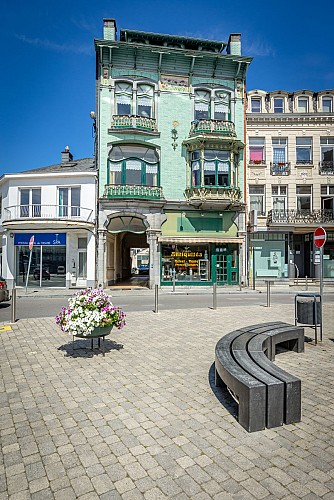
The Liege industrialist Victor COLLARD asked the architect Gustave CHARLIER to build him this second residence in 1902 in the centre of Spa. second residence in 1902 in the centre of Spa. The rich decoration of the façade, in glazed bricks, borrows its motifs from the plant world. In the centre, an iron sunflower is applied between the windows of the upper floors. Under the wide, concave, overhanging cornice, ceramic panels depict flowering poppies. Rich plant motifs also adorn the curved ironwork of the balconies and bow window. New possibilities of wrought iron are demonstrated. All of the curved period window frames in a darker green colour have been green colour have been retained. On the ground floor, built of limestone, the capitals on either side of the carriage entrance and the shop window are decorated with ivy and lizard leaves. All of these materials combine to create a colourful and decorative ensemble that is absolutely unique. The architectural and artistic qualities of this building were officially recognised by a classification order by a classification order issued in 1989. It protects not only the façade on the street side, but also the roof and the façade on the courtyard side, which is more simple, as well as the stairwell and the painted ceiling of a room on the first floor.

RUE PROMENADE DE QUATRE HEURES / N°6
This interesting house was built at the beginning of the 20th century according to the plans of the architect Marcel Hansen. All the characteristics of the Art Nouveau style can be found here. The cladding gives the façade a lot of light. It consists of white bricks interrupted by three bands of grey limestone on the upper floor. The high base of sandstone and limestone rubble is pierced by a large cellar window with a sinuous frame. It is protected by a beautiful wrought iron grille under a mosaic panel forming a red flower decoration. This panel, which is very modern for its time, is at the level of the passers-by and contributes to the polychromy of the façade. The door's joinery also belongs to the Art Nouveau style. So does the window above it, with its pointed arch in light blue bricks and its partially erased sgraffito panel. Sgraffito is a design incised with a fine chisel into a fresh wall plaster applied to a coloured stucco background. The lines of the incised drawing make the figures clearly legible to the viewer. This technique requires rapid execution and great dexterity. On the right, on the first floor, the bow window is supported by a triple wrought iron console whose design and curves suggest finesse and lightness. Under the cornice, panels of sgraffito decorated the semi-circular transoms. All the original woodwork has been preserved, with the larger windows having coloured stained glass. The building you see at the end of the square, on the left, is the Town Hall of Spa. Go back towards the Tourist Office and turn right into the Rue du Marché. into the rue du Marché. Take the Rue Royale and stay on the right-hand pavement. On your left you will see the Casino and the Anciens Bains. The former Spa thermal baths have been part of Wallonia's exceptional heritage since October 2016. Restoration work is underway and will make way for a luxury hotel, with shops, flats and parking spaces. You are now in Place Royale. On your right, you can see the Parc de Sept-Heures and the Pavillon des Petits Jeux, which now houses a micro-brewery: LA BOBELINE. Another exceptional heritage of Wallonia, the Galerie Léopold II, which you can see behind the pavilion, is a covered walkway typical of the water cities of the late 19th century. It connects this pavilion to the Marie-Henriette Pavilion (at the back of the park), which is also listed. Now take a closer look at the red brick building at the entrance to Avenue Reine Astrid.

AVENUE REINE ASTRID / N°1-3
At the corner of Avenue Reine Astrid and Rue du Fourneau, the building was constructed at the beginning of the 20th century to the plans of the architect Marcel HANSEN, who also signed the plans of numerous Spadois villas. The building is eclectic in style and has some Art Nouveau architectural elements. On the Avenue Reine Astrid side, two sgraffito panels decorate the façade with floral decorations. Two windows with horseshoe arches, one on the avenue side and the other on the park side, are also representative of the Art Nouveau movement. Art Nouveau was increasingly inspired by other styles, such as Moorish or Arab, whose exoticism adds to its originality. There is another Art Nouveau gem on the Avenue Reine Astrid, but this villa is further away (about 1 km from the centre of Spa, on the left-hand side of the avenue, towards Theux). We advise you to go there by car.

AVENUE REINE ASTRID / N°144
"Villa Emma". This house, built in 1855 and surrounded by a pretty garden lined with light green painted railings, offers an Art Nouveau décor brought in on the initiative of the mother of the Liège poet Félix BERNARD. Horizontal bands of glazed ceramic decorated with tulips with sinuous foliage emphasise the levels. An elegant veranda is attached to the left gable. Characteristic of the Art Nouveau style, ceramics partially or sometimes completely cover certain facades. These tiles are either specially created for a building or are produced in a standardised way, so that they can be chosen and assembled according to the models in the catalogues of the craft firms that produce them. The entrance door has interesting joinery with decorative wrought iron elements. In the centre of the facade, the loggia supported by metal brackets is framed by columns around which ivy wraps. The remarkable wrought iron armrests on the upper floor windows bear witness to the quality of the craftsman's work and the influence of the plant world in Art Nouveau ironwork.

PLACE VERTE / N°44-46
The façade of this building is covered with white plaster with decorative elements borrowed from Art Nouveau. The most striking feature is the wide frieze running under the cornice with its fine floral arabesque decoration. This motif also adorns the keystone of the lintels of the first floor windows. Flowers also punctuate the corners of the sills and the upper parts of the jambs of each window. On the lintels of the 2nd floor windows, the key is decorated with female faces and garlands in relief.

PLACE VERTE / N°49-51
In the centre of the square, this building has been covered with a decorative plaster that is very discreetly influenced by Art Nouveau: thin horizontal bands in relief link all the bays together. The traditional floral decorative elements are sometimes mixed with more Art Nouveau-like contributions. The aim is to embellish the buildings and give the city an additional attraction.

RUE DU VIADUC / N°1
At the corner of rue de Barisart, a tall apartment building painted white has many decorative elements in the Art Nouveau vocabulary: panels with floral motifs and stylised dragonflies under the upper floor windows, leafy decorations on the pilasters between the ground floor bays, finely moulded frames surrounding the windows. The overhanging cornice is supported by small carved wooden brackets. At the corner, a wrought iron railing protects a small balcony overlooking the two streets.

RUE DE BARISART / N°25
Close to the building on the corner of Rue du Viaduc, a surprisingly narrow dwelling is covered with a homogeneous cementing inspired by Art Nouveau. Nature as a principle of form is elegantly staged above the colonnette window, where graceful curves of stems and long, undulating foliage intertwine. The cornice is supported by four small brackets, each with a flower bud and dense foliage. On either side of the key to the second floor window, sinuous "whiplash" motifs suggest dynamism and movement

RUE DES ÉCOMINES / N°46
This white painted façade has a beautiful Art Nouveau decorative plaster. Above the windows on the first floor, three panels with interlaced and curved motifs occupy the spandrels. Each window on the upper floors is surrounded by a fine ornamental moulding and each sill is highlighted by an additional beaked moulding, characteristic of the style of the period. The cornice is supported by small brackets decorated with leafy motifs.Now continue towards the Place des Ecoles, which you will reach by turning right and walking up the street. To get the best view of this wonderful group of houses, head for the car park in the square.

PLACE DES ÉCOLES / N°23
The "Rayon de soleil" is the personal residence of the architect Arthur NOEL, built in 1908.Here, the decorative elements that adorn the façade refer to a geometric Art Nouveau style. The remarkable wrought iron railing of the balcony is particularly noteworthy, with the side sections offering a play of curves and counter-curves that is particularly representative of the Art Nouveau movement. The original frames are still in place. Some of the windows are decorated with stained glass. A blacksmith can bend the wrought iron into shapes reminiscent of nature's flowing forms. At the beginning of the 20th century this craft reached a peak in the treatment of this material

PLACE DES ÉCOLES / N°31 - 33
"Les Marronniers" and "Les Papillons".These two houses with yellow brick facades were built in 1905. Their names evoke nature, a subject appreciated by the Art Nouveau movement. Above each entrance door and the windows on the second floor, sgraffito panels personalise each of the two houses: decorations of chestnut leaves and flowers at number 31, floral motifs and butterflies at number 33. Beautiful sinuous wrought iron anchors, a further reference to Art Nouveau, adorn the two façades. All the original windows have been preserved. At no. 31, the two large left-hand bays on the upper floors each give access to a balcony with a wrought iron railing. At no. 33, a bow window was added in 1914 in place of the first floor balcony. The stained glass windows depict butterflies. The overhanging cornices are supported by fine carved wooden brackets.

PLACE DES ÉCOLES / N°35
The building has two decorative panels and a beautiful Art Nouveau inspired cornice. The facade is animated by horizontal bands of white bricks contrasting with the red bricks of the facing. Polychromy is an extremely important element in Art Nouveau architecture. It is provided by the variety of materials and decorative panels. Now walk up to the top of the Place des Ecoles and turn left. The top of the square is enclosed by a small group of houses, one of which has Art Nouveau elements.

PLACE DES ÉCOLES / N°18
"Villa Mon Rêve". This villa was built in 1899 to the plans of the architect Emile PETIT. A decorative plaster covers the façade. The balustrade of the balcony is a beautiful wrought iron work, particularly tinged with Art Nouveau. Leave the Place des Ecoles and go down the street. At the bottom of the square, turn right into Rue des Capucins. At the end of the street, you arrive at the Place Achille Salée. If you are a little tired, turn left and find the Tourist Office down Rue Dr Henri Schaltin, to the left of the Romanesque-Rhenish church of Saint Remacle. Built in 1885, it reflects the prosperity of Spa at the end of the 19th century. The more persistent visitors will turn right and walk up the rue du Waux-Hall, which then becomes the rue de la Géronstère. Their effort will be rewarded by discovering the last two houses of the "Art Nouveau" route as well as the prestigious Waux-Hall building. This former "house of games and meetings" dates from 1770 and is said to be the oldest casino in Europe still standing. You will see this vast pale pink building on your left, after about ten minutes of walking. This building, listed in 1936, has been on the list of exceptional heritage since 1993 and on that of the Walloon Heritage Institute since 1999. Continue up the Rue de la Géronstère on the left-hand pavement. Houses No. 14 and No. 24 are the last stops on this beautiful route.

RUE DE LA GÉRONSTÈRE / N°14
The façade of this small traditional house is covered with decorative plaster of Art Nouveau inspiration. Panels with stylised plant motifs between the windows and flowers in relief under the cornice are all elements borrowed from the style in fashion at the very beginning of the 20th century. The windows, door and decorative panels are further enhanced by curved and sinuous frames in relief on the entire façade.

RUE DE LA GÉRONSTÈRE / N°24
This traditional facade has been embellished by a careful decorative rendering combining stylised plant motifs and female faces in relief on the window lintels. The undulating hair underlines the curves of the lintels of the first floor windows. Long female hair and plant motifs are common in Art Nouveau and are a pretext for sinuous curves. Here is the end of the " Art nouveau " tour which made you discover 17 treasures of the heritage of our thermal town, candidate to a registration on the list of the UNESCO World Heritage with the " Great European Water Cities ". We hope that you have appreciated all the richness of this artistic trend and that you have had real blows of heart by admiring some facades.