






Wanderrouten in den belgischen ARdennen
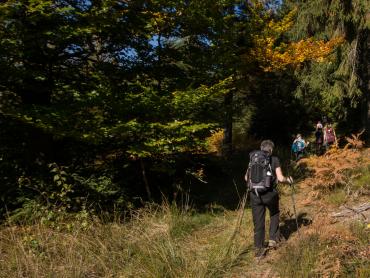
Die belgischen Ardennen erstrecken sich über die Provinzen Namur, Lüttich und Luxemburg, sowie einen Teil der Provinz Hennegau. Es gibt also zahlreiche Wandermöglichkeiten – die perfekte Spielwiese für alle Freunde des sanften Tourismus. Durch den Wald, über Felder, vorbei an Städten oder Dörfern, am Wasser entlang oder über felsige Bergrücken - es gibt für jeden Geschmack etwas.

Practice type
Walking
2h15mn
Ligny, battlefield

A 9 km trail exploring Ligny, a battlefield in 1815.
In Ligny, a peaceful village of 900 inhabitants, on June 16, 1815, two armies faced each other: Blücher's Prussian army, 87,000 strong and armed with 216 cannons, and Napoleon's French army, 65,000 strong and armed with 240 cannons. For six hours, fierce fighting raged in the streets, gardens, and houses of the village. By the end of the day, Ligny was ablaze, and thousands of corpses littered the battlefield.
Signalétique (EN)
No signage
Walking
Difficulty
Duration
2h15mn
Dist.
9 km
Practice type
Walking
2h15mn
Show more information
À proximité
Nearby tours
Nearby of points of interest
Map background choice

IGN Map

Aerial Photos / IGN

Slope Map (IGN Plan)

Map 1950 / IGN

State Major Map (1820-1866)

Open Street Map
Lat : 50.51407Lng : 4.57983
Coordinates copied

Terra Curiosa
Author

Ferme d'En-Haut
Places of interest
Ruelle du Curé 5140 Ligny
Ligny Canon
Places of interest
This fortress cannon tube, named "Le Formidable", weighs 5,600 kg and was cast in Douai (France) in 1811. It constitutes the centerpiece of a monument erected in 1969 in memory of the civil and military work of Napoleon, victor of the Battle of Ligny.
Rue Désiré-Harzée 5140 Ligny
Ligny 1815 Museum
Places of interest
"Go back in time and re-live Napoleon's last victory, at Ligny on 16th June 1815, two days before his defeat at Waterloo. Seven rooms take you on a journey of nearly 200 years into the past. • Historical centre ""Général Gérard"". Audioguide. • Museum, souvenir shop, refreshments. • Large parking. Less than 1km from the station. • Can be combined with other visits."
23 Rue Pont-Piraux 5140 Ligny
La Cornaille
Places of interest
Rue Lucien-Ponlot 5140 Ligny
La Tombe
Places of interest
Rue de la Tombe 5140 Ligny
Ferme du Moulin
Places of interest
Rue de Sombreffe 5140 Ligny
Panorama of Tige Street
Places of interest
Take a look at the beautiful panorama of the Ligne Valley. Straight ahead lies the village of Ligny; to the left, that of Sombreffe with its church steeple; and to the right, you can see in the distance the Fleurus water tower, near which stands the Naveau mill, which served as an observatory for Napoleon.
Rue du Tige 5140 Ligny
Place de Ligny
Places of interest
Place de Ligny 5140 Ligny
AlertAlerts
Powered by Cirkwi - Read Terms of Use