Alle Wanderrouten in der Übersicht
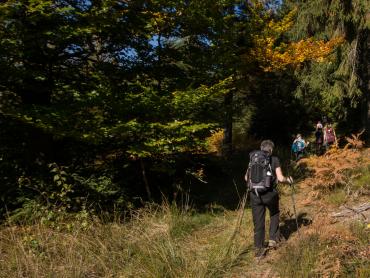
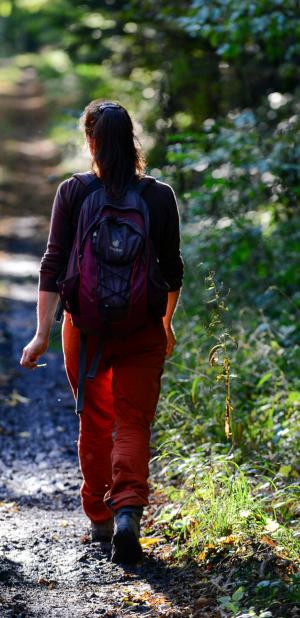
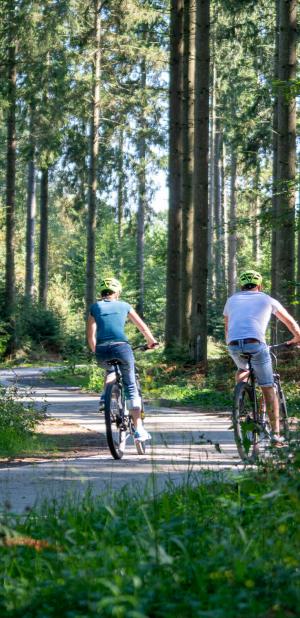
Die Wanderwege in den Ardennen sind so vielfältig wie die Landschaften, die sie durchqueren. Ob Ihr nun auf der Suche nach einer ruhigen Wanderung mitten durch den Wald seid, lieber an einem Fluss entlang marschiert oder durch historische Dörfer wandert: In den Ardennen gibt es eine schier unendliche Vielfalt an verschiedenen Wandermöglichkeiten! Sämtliche Routen könnt Ihr auf Euer jeweiliges Niveau und Eure Wünsche abstimmen.
Also Schuhe an, Wanderroute wählen und auf zu einem der zahlreichen Wanderwege in den Ardennen!
The Alley Walk


Discover a walk of around 4.5 km that you will not regret trekking!
Wander through the alleys of Cerfontaine to get a special perspective on our village.
This trek and these alleys, used for centuries to link the different neighbourhoods, are an integral part of our History.
Pass close to the former clog-making factory; the Carrière des Vaux, ancient quarry (if you dare discover its beauty in a small round trip); shortcuts; plains; fields; forests... History is everywhere.
Follow the green rectangle markings.
Ja. Dogs are to be held on a leash (mandatory in the Carrière des Vaux quarry).

IGN-Plan

Luftbilder / IGN

Hangneigungskarte (IGN-Plan)

Karte 1950 / IGN

Generalstabskarte (1820-1866)

Open Street Map
5630 CERFONTAINE

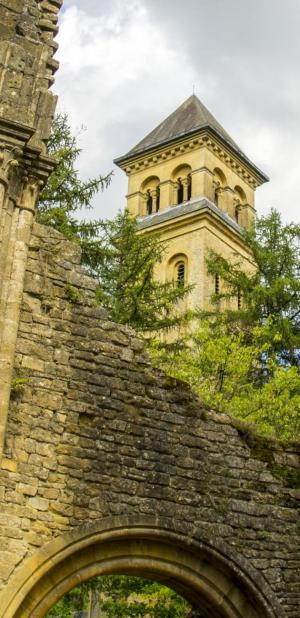
Church Saint Lambert
Neo-gothic church with three naves.
Dedicated to Saint Lambert, first bishop of Liège, who brought gospels to this area, and who was killed in 705.
The first stone as laid on September 6th 1880. Officially finished on October 13th 1884.
The octagonal belltower is a near-perfect replica of the old church that used to be situated 200 meters to the East, in the Pillory Neighbourhood. This type of belltower is called Barbican Belltower. The entire building was built using stones from the Valizes, about 250 meters south.

The Radia
The Radia is the named of the river 'Eau d'Heure' when it's crossing the village of Cerfontaine. That nickname could come from the latin word 'rapidellum', which means 'little rapid'.
The Eau d'Heure's name itself, 'hour's water' has several roots: one of them, the most popular, tells the tale that it can overflow in less than an hour... Ur is a preceltic word meaning 'river', close to the rivers Our or Aar. We can find traces of that word, Ur, in Emperor Othon's diploma in the Abbey of Lobbes in 973. Other names, however, can be found, like Edera or Hodeuse...
Centuries ago, it's possible that the river served as a border between Walcourt and Cerfontaine, between the paguses of Lomme and of the Sambre.

Centenary Tree for the Centenary of Belgium's Independance
This tree was planted on September 7th 1930 for the centenary of our independance, as seen on the plaque that was officialised on August 15th 1978.

The Donkey Path
This path used to link the centre of the village and the mill. Imagine the donkeys that climbed down here, carrying sacks of wheat, coming back up with bags of flour and bran.

The old pillory
It's in this spot that used to be situated the old pillory, where criminals were exposed to the public. Until 1914, Shrove Tuesday ended on this small square: the 'cryêye' on Shrove Monday, and judgment and execution on Shrove Tuesday.

The old church
The old church, demolished around 1890 was situated where today's daycare's parking lot is. Visitors can still see the cross of an old priest in the wall. He died there in 1838, going out of his own house.

Saint John the Baptist Chapel
All of the numerous chapels in the village of Cerfontaine are listed in the church Saint Lambert in a 'giant album' that visitors can have access to. The oldest chapel is the one dedicated to Saint John the Baptist, built in 1963. There are more than two dozen other chapels around Cerfontaine that are generally well kept by the public. You can also have access to the white trek of the Syndicat d'Initiative, that pass close to all the chapels in the village.

Carrière des Vaux
This limestone quarry was closed in the 1980s and is situated in the East of Cerfontaine, very near to the Lacs de l'Eau d'Heure. Its fate is, in fact, closely influence by that of the dams that were built in the 1970s and that, today, are a visitors' attraction.
The Carrière des Vaux is a haven for different types of plants that thrive in a limestone environment, as well as rarer species of flowers and trees. Around the water's edge, there also are several species of amphibians and reptiles, as well as birds.
In 2004, the whole complex was made a state-owned Wildlife Park, and is about 16 ha.

Tchâfour Fountain
Proof of the rich underground water network under Cerfontaine, this fountain, which name means 'Small Oven Fountain' in walloon, is where an old spring comes back over ground after around 200m underground. Our ancient ones believed that it was linked to the harbour in Lisbon, because its waters were dulled in 1755, when a terrible earthquake struck the Portughese capital city.